Lensmor is a good fit for teams that want to research trade shows, work in their own CRM, and use event data in their sales tools and AI assistants. Vendelux is worth considering if you also want a provider to run event campaigns for you.
Lensmor now supports HubSpot, Salesforce, and Attio imports and exports, with REST API and MCP access for paid subscribers. Our iOS app brings individual-event data onto your phone, along with business-card scanning, badge scanning, and notes.
Pricing remains a clear difference. Lensmor publishes its standard plans, starting at $499/month. Vendelux asks you to contact sales for a platform quote.
Here's how the two products compare on price, data access, integrations, mobile use, and outreach.
Written by the Lensmor team. Updated November 2, 2026. The UNBOUND export example below comes from our October 13 test.
Lensmor vs Vendelux at a glance
| Feature | Lensmor | Vendelux |
|---|---|---|
| Event research | Event, exhibitor, and people research, including company and person event footprints | Event discovery, audience research, and account-based event planning |
| Platform pricing | Basic: $499/month or $4,990/year. Growth: $14,900/year. Enterprise: custom | Contact sales for pricing |
| Data access | Unlock the available data for an event; reveal contact details separately | Profile access through lead credits; separate campaign allowances |
| CRM | HubSpot, Salesforce, and Attio imports and exports | Salesforce and HubSpot integrations, with event and pipeline context |
| API and AI access | REST API and MCP access for paid subscribers | Ask sales about API availability and plan requirements |
| Mobile | iOS event-data viewing, business-card and badge scanning, and notes | Lead Scanner app for onsite capture |
| Outreach | Your team runs outreach through its chosen tools | Managed campaign services available |
Lensmor vs Vendelux pricing: public plans and quoted contracts
You can see Lensmor's subscription prices before booking a sales call. Basic costs $499/month or $4,990/year and includes 35,000 credits per month for up to five users. Growth costs $14,900/year, with 1.5 million credits per annual term for up to 10 users. Enterprise pricing is custom.
If you need Basic throughout the year, annual billing saves $998 compared with 12 monthly payments. If you only need access for a few months, monthly Basic lets you budget around that period: three months cost $1,497.
Basic credits reset each month, including on the annual plan. Growth's allowance resets at annual renewal. Unused subscription credits do not roll over, so the timing of your research matters as well as the number of events.
How much does Vendelux cost?
Vendelux doesn't publish its platform prices, so you'll need to speak with sales for a quote. Its packages combine event intelligence with different data allowances, CRM functions, and campaign services.
With Lensmor, you can check the subscription price, included users, and credit costs before booking a call.
Vendelux's free Lead Scanner is a separate offer from its paid intelligence platform. If scanning is all you need, compare the mobile apps first; you may not need to buy an event-research subscription.
Compare the cost of the whole workflow
For a team that already has a CRM, enrichment credits, and an outbound process, the main purchase may be event research. Lensmor can supply that research while the team keeps using its existing tools.
If you need help running campaigns, include the people doing that work in the comparison. Vendelux's managed service may cover work that your team would otherwise do itself or hire an agency to handle.
In either case, price the work you're actually buying: the events you need, the people using the software, the contacts you want to reach, and who will run the outreach.
Lensmor lets you research an event before spending on contacts
In Lensmor, Base Event Access costs 2,000 credits. It opens the available Exhibitor and Social Signal Attendee records for that event. You can then filter companies and people, review their event connections, and build your shortlist.
Full Access costs 5,000 credits and adds available Visitor data. If you've already bought base access, the Visitor upgrade costs another 3,000 credits. Coverage varies by event and source.
This lets you start with the event and narrow the list before spending credits on contact details. You might find 100 companies worth researching but only 20 people you want to contact this week.
Emails and phone numbers are a separate decision
Revealing an email costs 15 credits when returned; a returned phone number costs 150 credits. Event access doesn't include every hidden email or phone number.
Here's what a shortlist could use after one base event unlock:
| Research task | Total Lensmor credits |
|---|---|
| Unlock base event data and export available profile fields | 2,000 |
| Also reveal 100 emails, assuming all are returned | 3,500 |
| Also reveal 20 phone numbers, assuming all are returned | 6,500 |
These totals exclude a Visitor upgrade and any other paid actions. The credits come from your subscription allowance; they aren't separate dollar prices for each event.
Vendelux uses lead credits for profile access. When comparing allowances, look at how many relevant people you can research and which contact details are included. An event unlock and a profile credit count different things.
API access and CRM handoff
Lensmor now supports HubSpot, Salesforce, and Attio, with imports and exports across all three. Salesforce and Attio join the HubSpot integration that earlier comparisons focused on.
If your team uses Salesforce or Attio, you can keep that CRM and use a supported connection to move data between it and Lensmor. You don't have to choose HubSpot to use a Lensmor CRM integration.
Salesforce, HubSpot, and Attio: what changes for your team?
The CRM is where your team already manages accounts and follow-up. Lensmor adds the event research: which shows to look at, which companies fit, and which people are worth approaching.
Import and export support gives that research a route into your existing sales process. Your CRM's objects, fields, and permissions still determine the details of the connection.
Vendelux's CRM integrations emphasize Salesforce and HubSpot, including deal context and event-level pipeline reporting. If that reporting is central to your event program, it belongs in your demo.
The distinction is now about the work you need the integration to do. Salesforce availability alone is no longer a reason to rule Lensmor out, and Attio teams have a supported option in Lensmor too.
REST API and MCP: use event intelligence in your own workflows
Paid Lensmor subscribers can access both the REST API and MCP service. These give developers and sales teams ways to work with Lensmor outside the web interface.
Use the REST API for repeatable research
The Lensmor API covers events, exhibitors, people, contact enrichment, credits, and profile matching. Paid subscribers can create a key in Settings → API Keys.
A RevOps team could use it to pull exhibitor records for selected events, apply its own account rules, and prepare a research list for sales. A developer can build that process into an internal tool instead of making someone repeat the same searches and exports each week.
You control the code, scheduling, and destination. Lensmor supplies the supported data and operations, with credits and rate limits applying to usage.
Use MCP from a compatible AI assistant
MCP connects a compatible AI assistant to Lensmor's exposed tools. It gives a team that already uses an AI assistant another place to do event research, rather than moving every task back into a separate browser tab.
The available operations depend on the current MCP tools. For a custom software integration, the REST API is the more direct route; for working through a compatible AI assistant, MCP provides the connection.
How does this compare with Vendelux API access?
Vendelux's terms mention API delivery, but its public plan page doesn't explain a comparable API and MCP package for paid subscribers. API access is a question for its sales team.
Lensmor makes both access methods available to paid subscribers. For teams building their own sales tools or using AI assistants for research, that is a reason to put Lensmor on the shortlist.
Mobile apps: event data, card scanning, and badge capture
You can now use Lensmor on an iPhone to view data for individual events, scan business cards and badges, and add notes.
That is useful beyond the booth. You can look up an event's companies and people while walking the floor, capture someone you meet, and write down what you discussed before the next conversation starts.
| What you want to do | Lensmor iOS |
|---|---|
| Review an event on your phone | View individual-event data available through Lensmor |
| Capture a business card | Scan the card |
| Capture an event badge | Scan the badge |
| Remember the conversation | Add notes |
Lensmor Card & Lead Scanner is available on the App Store. Scanning and saving contacts on your device are free; a Lensmor account is required.
Captured contacts and notes are saved on your device, with CSV export for follow-up.
Vendelux Lead Scanner offers free badge and business-card scanning with enrichment and CRM handoff. That is a useful option for teams looking for a capture app. With Lensmor, you can also view your event research on mobile while using scanning and notes.
Already paying for enrichment? Keep using it
If you already pay for Apollo or another contact-enrichment service, you can keep using it with your Lensmor research.
Unlock an event, narrow the companies and people to a shortlist, and export the available identity fields. Your enrichment provider can then search for the details you still need. You don't have to buy Lensmor contact reveals before exporting those fields.
Hidden emails and phone numbers stay hidden in the export until revealed. This is a choice of where to do enrichment, with each provider's own credits, coverage, and costs.
For a team with unused enrichment capacity, this can avoid buying the same contact details twice. It also lets you choose where to spend: more event research, more emails, or phone numbers for a smaller group of prospects.

Which workflow fits your team?
A five-person team already using a CRM and enrichment tool
Basic supports up to five users. If your team already works in HubSpot, Salesforce, or Attio, and has an enrichment and outreach process, Lensmor can fill the event-research gap.
You can build a target list before the show, use your existing tools for missing contact details, and keep follow-up in your current CRM. The API and MCP options are there when you want to automate part of that research.
A team researching only three trade shows
Three base event unlocks use 6,000 credits. If you also receive 50 emails per event, the 150 emails use another 2,250 credits: 8,250 credits total, excluding phones, Visitor upgrades, and other actions.
That fits within Basic's 35,000-credit monthly allowance if you do the work in one billing period. If the work spans three monthly subscription periods, the subscription payments total $1,497 and the allowance resets each month.
This is why your research calendar matters. Three shows researched in one month and three shows spread across a quarter can have the same credit usage but different subscription costs.
A RevOps team building an AI-assisted process
Lensmor is worth considering if you want event intelligence inside a process your team builds and owns. The REST API supplies data to software; MCP connects Lensmor tools to compatible AI assistants.
You can start with one recurring job, such as preparing exhibitor research for an account owner, and build from there. You keep your team's account rules and review process instead of changing them to fit a vendor's campaign service.
A real example: filtering and exporting a UNBOUND shortlist
In our October 13, 2026 test of UNBOUND 2026 in Lensmor, the page showed 118 exhibitor companies and 8,819 people records.
We filtered the people list for Captello, which returned six profiles, selected two, and downloaded a CSV. Here's what came through:
| Field | Result in the two-row export |
|---|---|
| Name, title, company, and company URL | Present |
| Present for one person | |
| Email, phone, and WhatsApp | Blank; we hadn't requested contact reveals |
| Source and historical-event counts | Included |
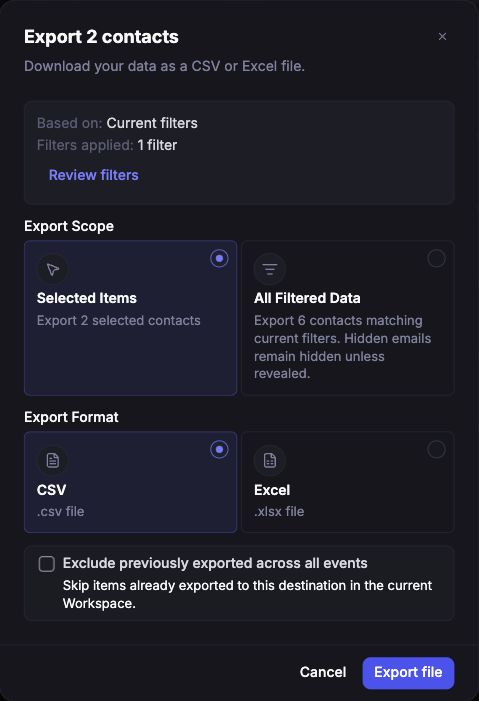
The file gave us names and company context for the next research step. We could then choose whether to reveal contact details in Lensmor or use an existing enrichment provider. Neither person's registration was confirmed by this export.
Compare evidence, not just database size
A large database helps only if it covers your events and contains people relevant to your team.
In Lensmor, Exhibitor, Social Signal Attendee, and Visitor records have different sources. An official exhibitor listing connects a company to a show. A social signal connects a person to the event through public activity. Visitor data, where available, has its own source and event edition.
Those distinctions matter in outreach. “Your company is exhibiting” and “I saw your post about the event” give a rep different reasons to get in touch. Neither should become “You're registered to attend” without evidence about that person.
Vendelux also describes historical and predicted attendance in its event intelligence. Whichever platform you use, look beyond the headline count: are the accounts you care about represented, are the people still in the right roles, and is the event connection recent enough to use?
When Vendelux may be the better fit
If your team needs someone to run outreach, Vendelux Campaigns is worth a closer look. It offers a dedicated outreach team and campaign coordination.
Lensmor leaves campaign execution with your team and its chosen tools. That suits a business with an established sales process. If you don't have the people to prepare messages, manage replies, and coordinate meetings, a managed service may be worth paying for.
Vendelux's event-level pipeline reporting may also matter to a team managing a large event program. Consider that alongside your current CRM reporting and the data you need to explain event spend.
Five questions to ask before choosing an event intelligence tool
- Does it cover our next events? Look at the actual editions and target accounts you need.
- Why is each person on the list? Check the event source and distinguish predictions from confirmed participation.
- What will our program cost? Include seats, data access, contact details, and campaign work.
- Will it fit how our team works? Try the CRM connection, mobile tasks, or API/MCP access you plan to use.
- Who will do the outreach? Decide whether you need research software, execution support, or both.
Choose based on your team's next event
Choose Lensmor if you want event research with published pricing, CRM choice, and access to the data through API and MCP. You can keep using HubSpot, Salesforce, or Attio, and take event research, scanning, and notes onto your iPhone.
If you also want a provider to run campaigns, include Vendelux in your evaluation and price that service alongside the software.
The quickest way to see whether Lensmor fits is to open an event you know, find a few target accounts, and build a shortlist your team would actually use.
Start Free Trial with 2,000 credits and no credit card required. That's enough for one base event unlock. Contact reveals and Visitor access use additional credits.
For more options, see our Vendelux alternatives guide.