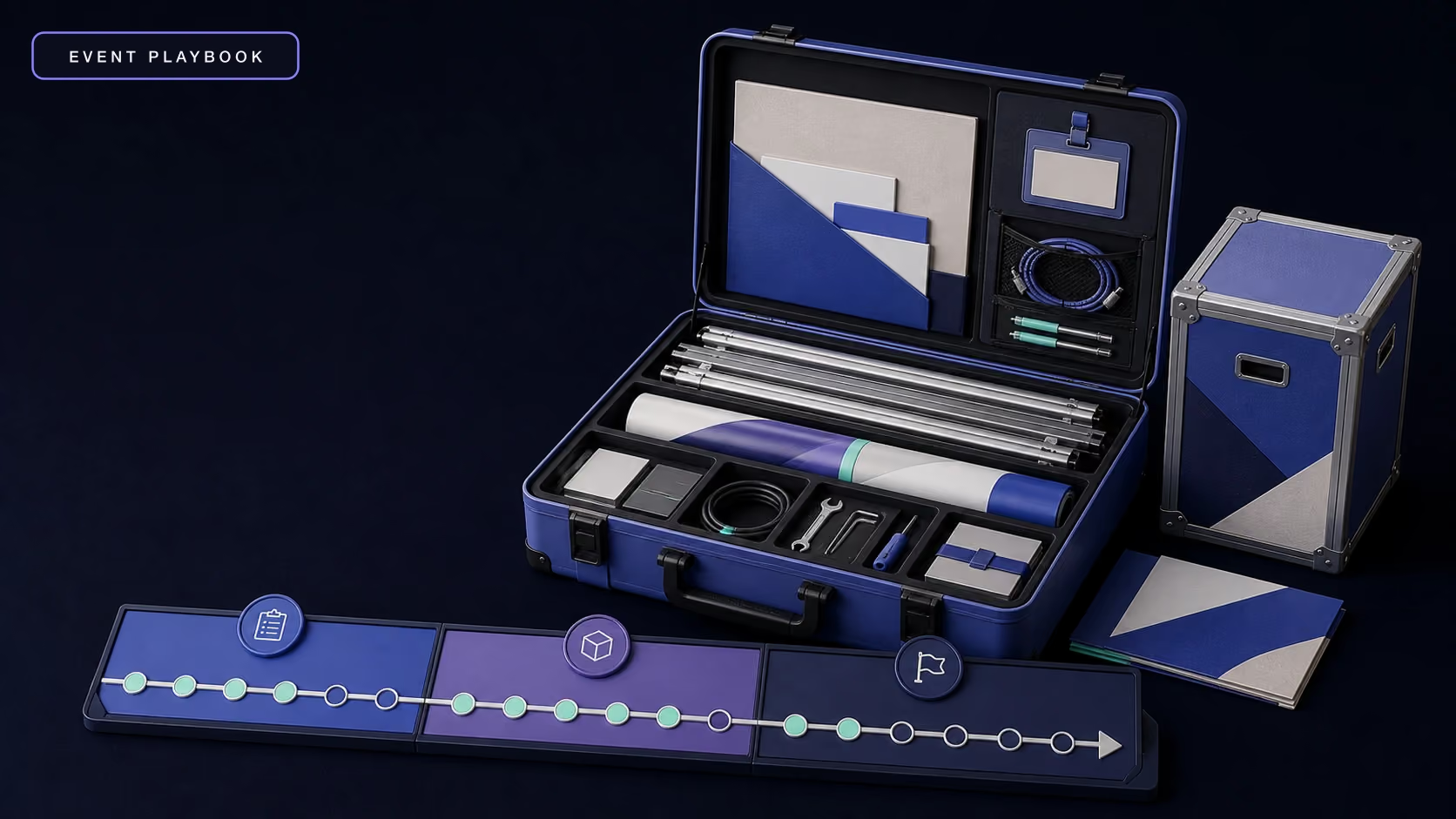
Every task a first-time exhibitor needs to complete — organized by when it needs to happen. Five phases, 66 items, one timeline. The part most exhibitors skip: the highest-ROI work happens before you ever load the van.
Trade shows cost between $15,000 and $50,000 when you add booth fees, travel, and staff time. This trade show exhibitor checklist — covering how to prepare for your first trade show — flips that ratio — most first-timers spend 80% of budget planning display and 20% planning who to meet. It should be reversed.
If you're 60 days out, start at Phase 1. If you're 30 days out, skip to Phase 2 and move fast.
60 Days Before the Show

Phase 1 — Strategy & Research
Use this exhibitor planning timeline as your master sequence — starting with research. The fastest way to build your target account list: see how exhibitors capture leads at trade shows before they even arrive.
This phase is about decisions, not logistics. Every dollar spent here saves three at the show.
- Set your North Star metric. Pick one: SQL count, meeting count, or partner conversations. "Brand awareness" is not a metric.
- Get budget approved. Booth cost × 3 = total show cost. Get sign-off in writing before any vendor contracts.
- Confirm your ICP for this show. Job title, company size, industry — write it down. This filters every decision that follows.
- Map the exhibitor list to your ICP. Filter by company size, industry, and job titles attending. Use Lensmor to pull it automatically — this is your pre-show outreach shortlist.
- Book your booth space. Corner booths get 40% more traffic. If unavailable, choose end-of-aisle. Avoid the back wall on your first show.
- Assign your booth team. One product expert, one SDR-style qualifier, one logistics lead. Don't default to "whoever is available."
- Book flights and hotels. Prices spike 6–8 weeks before any major B2B conference. Book now.
- Select your lead capture tool. Badge scanner ($300–$900 rental) or lead capture app. Decide now — not on setup day.
- Brief your marketing team on collateral. One-pager, leave-behind card, or demo sheet. No walls of text. One value proposition per piece.
- Order swag. Anything custom-printed needs 4–6 weeks. Order now or you're paying rush fees.
- Check for speaking or sponsorship slots. Most close 60–90 days out. A 20-minute breakout multiplies meeting conversion vs. booth-only traffic.
- Set up your demo environment. Write the 90-second demo now. Know exactly what you're showing and who it's for.
30 Days Before the Show

Phase 2 — Outreach & Operations
By now you know who you want to meet. This phase is about making sure they know you're coming.
- Start pre-show outreach. Email and LinkedIn every ICP-matched company. Message: "We'll both be at [Show]. Can we book 20 minutes?" Use Lensmor to pull and filter the exhibitor list. Target: 20–30 confirmed meetings before doors open.
- Finalize booth design. Design sign-off must happen by day 30. Printers need 10–15 business days. Late changes cost 2–3× the normal rate.
- Finalize marketing collateral. Final proof, print, and ship. Don't bring 500 copies of something that isn't done.
- Run staff training sessions. Drill the qualifying question sequence and the 90-second demo. Everyone handles objections and transitions to a meeting ask.
- Write your lead qualification script. The 5–7 questions that separate an SQL from a business card. Print it for your team.
- Set up your meeting scheduling tool. Calendly or HubSpot meetings. Include the link in every outreach email.
- Configure CRM pipeline. Create a show-specific pipeline stage so you can separate show leads from inbound leads in your reporting.
- Draft follow-up email sequences. Three versions: met at booth, walked by, pre-booked meeting. Write them before the show.
- Confirm logistics and shipping. What is being shipped to the show? What is hand-carried? Get tracking numbers for everything.
- Test your lead capture app end-to-end. Scan a test badge, add notes, push to CRM — before the show floor.
- Confirm travel itinerary with the full team. Flights, hotel, booth address. No surprises on setup day.
- Set up your post-show reporting template. Define SQLs, CPL, and meetings-to-close before the show, not after.
14 Days Before the Show
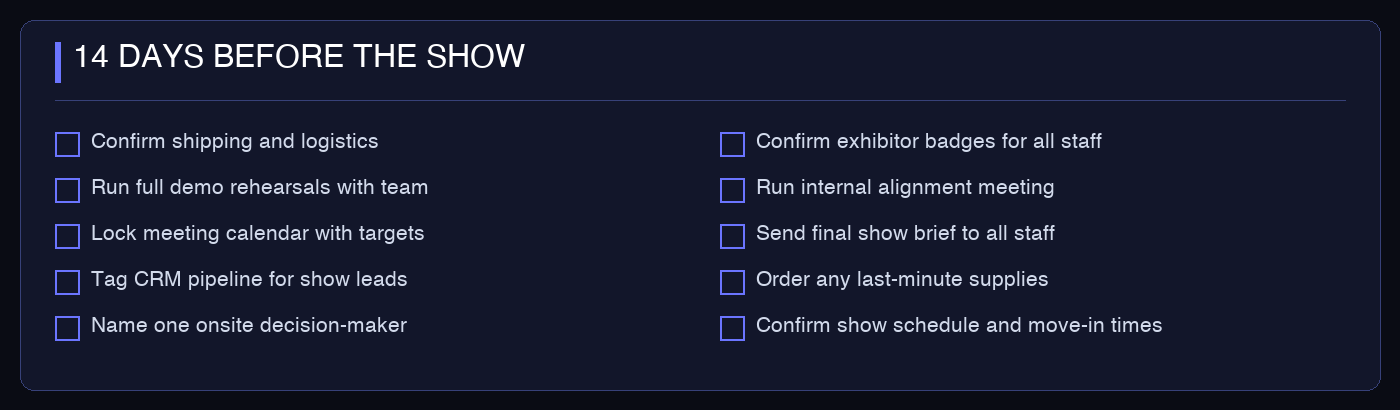
Phase 3 — Final Prep
- Confirm all shipping is en route. Get tracking numbers. Verify delivery against show move-in dates.
- Lock in all pre-show meetings. Send calendar holds with location details. Expect ~30% no-show rate — plan your schedule around confirmed slots.
- Run a full demo rehearsal. Full team, full demo, timed. Every person handles objections and transitions to the meeting ask.
- Tag your CRM pipeline with show context. Flag existing accounts attending so your team knows who to prioritize on the floor.
- Do a final booth materials checklist. Signage, swag, lead capture devices, power adapters, demo materials — nothing left behind.
- Order show services. Electricity, hardline internet, furniture, cleaning — confirm all orders are processed. Convention center services close 7–10 days out.
- Distribute the final show brief. One-page document: team schedule, booth assignment, qualifying questions, top 10 target accounts, meeting schedule, and emergency contacts.
- Confirm your lead enrichment workflow. Leads move from capture app to CRM with correct tags. Do a dry run before you leave.
- Brief whoever is holding down the office. Who handles urgent deals while your team is on the floor?
- Get your competitor intel together. Which competitors are exhibiting, where are their booths, and what's their pitch this year?
Day-of Setup Checklist
Your trade show booth checklist for the day itself — from pre-dawn setup through close of show.

Phase 4 — Show Floor
- Arrive during move-in, not at opening. Setup takes longer than expected. Build in two hours of buffer before the doors open.
- Unbox and inspect everything before setting up. Damaged displays, missing components, and wrong-size furniture are easier to handle before the show, not during.
- Test all power and connectivity first. Plug in every device before building around it. Get a dedicated hardline if you're demoing software.
- Test lead capture tools on the actual floor. Badge scanners behave differently inside show halls. Test with a real badge before doors open.
- Run your team briefing. 15 minutes, standing, before the floor opens. Roles, top target accounts, first meeting on the schedule, qualifying questions review.
- Distribute the daily schedule. Each team member has their meeting list, coverage rotation, and break times printed or on their phone.
- Stock swag and collateral. Front-load the booth with material for the first rush. Restock during quieter periods — not when you're in a conversation.
- Identify the emergency kit location. Tape, scissors, extension cords, Tylenol, phone chargers. Know where they are.
- Brief your photographer or videographer. If you hired one: where to be, what moments to capture, how to avoid disrupting active conversations.
- Do a competitor walk before your floor opens. 20 minutes. Note their messaging, offers, booth traffic patterns. Useful for your debrief and your next show.
Post-Show Checklist (72-Hour Window)
Phase 5 — Follow-Up
35% of trade show leads never get contacted within 72 hours. That window is when your conversation is freshest and your lead is most receptive. Don't waste it.
- Upload all leads to CRM within 24 hours. Every badge scan and business card. If it isn't in CRM it doesn't exist.
- Score and tier your leads. Tier A: ICP + need + agreed next step. Tier B: ICP fit, no clear pain. Tier C: everyone else.
- Send Tier A follow-up within 48 hours. Reference something specific from the conversation. One ask. Not a product brochure.
- Send LinkedIn connection requests. Every person you spoke with. Include a note that references the show.
- Schedule the debrief meeting. Full team within 5 days: what worked, what didn't, what to change next show.
- Calculate your ROI. Total cost ÷ SQLs = cost per SQL. This is the baseline for your next show decision.
- Document your learnings. Booth location, messaging, qualifying questions — what to repeat and what to change.
- Send thank-you notes to key contacts. Handwritten for the 3–5 relationships where a deal is possible within 90 days.

What to Pack: Exhibitor Packing List
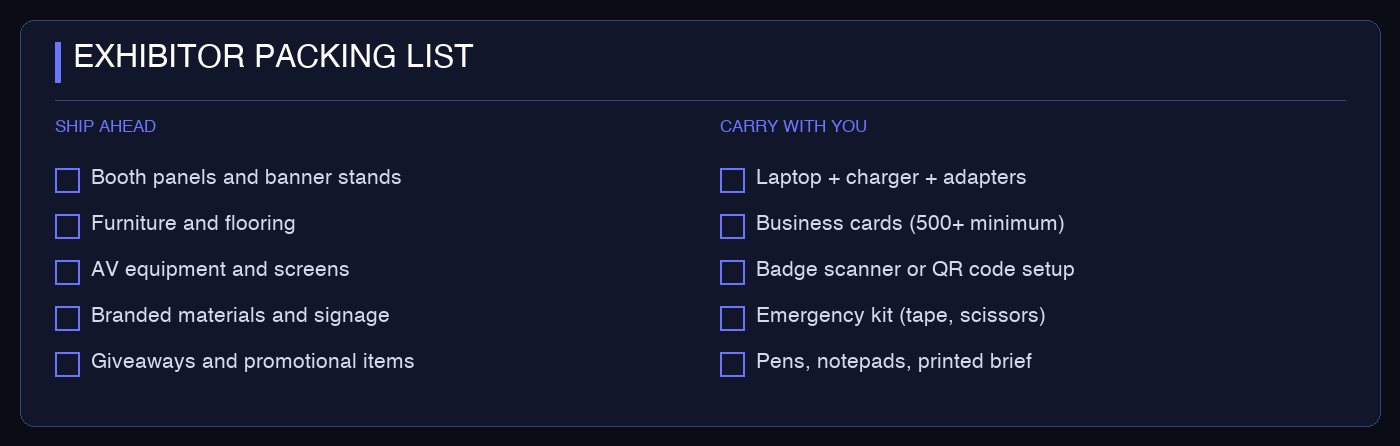
What to bring to a trade show as an exhibitor splits into two lists: what gets shipped ahead with your booth materials, and what travels with you on show day.
Trade show packing list — Ship ahead (arrives at show with booth materials):
- Signage, banners, backdrops
- Branded tablecloths and furniture covers
- Swag (bulk items — printed shirts, tote bags, branded merchandise)
- Product brochures and one-pagers (qty: 1.5× expected daily foot traffic)
- Demo devices if shipping separately from your team
- Extension cords and power strips (show floor outlets are rarely positioned for convenience)
Carry with your team:
- Lead capture devices (badge scanner, tablets for capture apps)
- Backup phone chargers and battery packs
- Qualifying question cards for each team member
- Business cards (even if you rarely use them — some attendees still expect them)
- Show brief and daily schedule, printed
- Emergency repair kit: duct tape, zip ties, scissors, double-sided tape
- High-protein snacks (booth catering is expensive, breaks are short)
- Comfortable shoes — non-negotiable for a 10-hour day on concrete
First-Time Exhibitor Budget Template

These are typical ranges for a 10×10 inline booth at a mid-size B2B conference. Corner booths and larger spaces scale 2–4× these figures.
The "booth cost × 3" rule holds reasonably well. If your booth fee is $5,000, budget $15,000–$20,000 total and you won't be surprised.
Free Download: 60-Day Exhibitor Checklist PDF
Get the Free 60-Day Exhibitor Checklist PDF
66 checklist items + packing list + budget template — ready to print or share with your team.
Enter your details to receive the PDF instantly.
FAQ
How much does it cost to exhibit at a trade show for the first time?
Budget $15,000–$25,000 all-in for a 10×10 at a mid-size B2B show (booth rental, display, travel for two, shipping, show services). Corner booths or large shows (CES, HIMSS) run $50,000–$150,000+. Rule of thumb: multiply the booth fee by 3.
How do I choose the right trade show as a first-time exhibitor?
Request the previous year's attendee report. Match job titles and company sizes against your ICP — if fewer than 15–20% fit your target buyer, the ROI rarely works. Walk the show as an attendee first if possible.
What's the biggest mistake first-time exhibitors make?
Showing up without pre-booked meetings. Teams that do pre-show outreach from the exhibitor list report 3–5× more meetings and lower cost per SQL. That work starts in weeks 4–6 of this timeline, not on the floor.
How many staff do I need at my first trade show?
Minimum two for a 10×10 — one for active conversations, one for walk-ins. Three is better with a heavy meeting schedule. Don't overstaff: more than four in a small booth reads as desperate.
When should I start planning for my first trade show?
Minimum 8 weeks for a team with existing materials. For a true first-timer, start 3–4 months out — premium positions and speaking slots close 90+ days early. Pre-show outreach needs 4–6 weeks to generate confirmed meetings.
Do I need to hire a booth builder or can I DIY my first trade show booth?
A pop-up display with branded graphics is DIY-friendly and costs $800–$3,000. Custom builds add $5,000–$20,000 — unnecessary for a first show. Rent from the show's official contractor if you need a larger footprint.
How do I generate leads at a trade show as a first-time exhibitor?
Pre-show outreach is the highest-ROI method — identify exhibitors, map them to your ICP, and book meetings before doors open. On-floor badge scanning only captures booth visitors. Lensmor's exhibitor intelligence gives you the full list.
What should I do with leads after a trade show?
Upload to CRM within 24 hours. Send personalised follow-up within 48 hours referencing the specific conversation. Tag Tier A (call within 72 hrs), Tier B (nurture), Tier C (quarterly). Response rates are 3–5× higher in the first 72 hours.
How do I ship my booth and materials to a trade show?
Ship to the advance warehouse 7–10 days before the show — cheaper than direct-to-show and avoids setup-day delays. Use the show's official contractor for drayage. Label every crate with company name, booth number, and contact.
What technology do I need at my trade show booth?
Essentials: lead capture app, tablet for demos, portable Wi-Fi hotspot (venue Wi-Fi is unreliable), power strip, charging cables. Nice-to-have: TV for demo video loop and a QR code linking to your booking calendar.
Build Your Pre-Show Pipeline Before the Doors Open
If you're booking a trade show in the next 90 days, the pre-show outreach phase is where the ROI is. Lensmor pulls the exhibitor list, scores it against your ICP, and drafts your outreach in minutes — not hours. Teams that start 4–6 weeks out consistently book 8–15 meetings before the show floor opens.
See How Lensmor Works →